Admission Form For Pre-primary Section
  Download
 Nr Super Society, Ramdev Nagar, Satellite, Ahmedabad, Gujarat 380015
 079 - 26920026, 26921045, 40322444/45/46
 info@rhkapadia.org


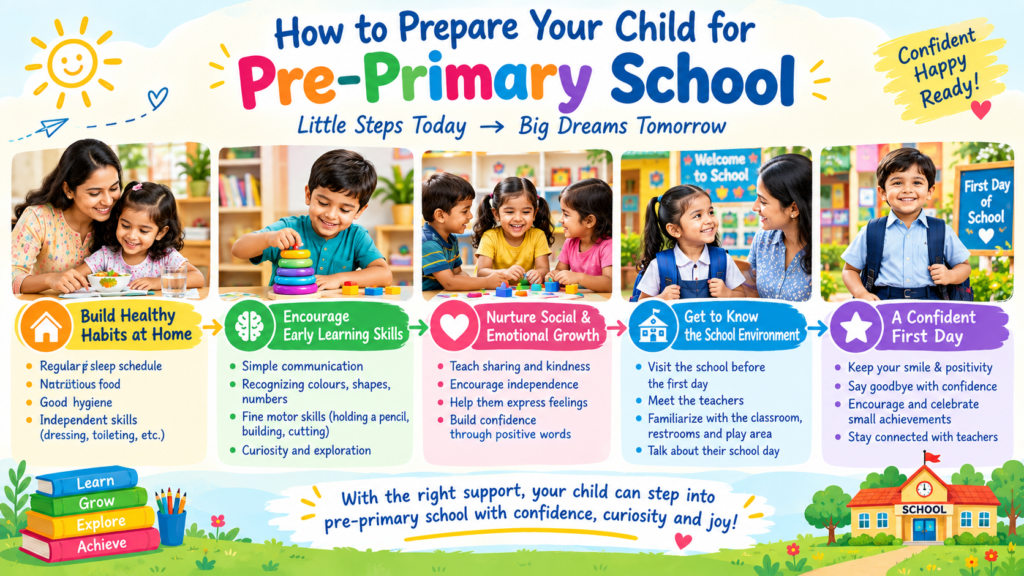
Preparing your child’s entry into pre-primary school can be anxious times for many parents. For a child, it is the first exposure to spending several hours away from home, meeting new people, a new routine and finding their way around a classroom environment.
For you, it’s totally normal to question if your child is ready for school.
Good news is, getting your kid prepared is not about teaching them everything before heading to the school gate. The objective is to make them confident enough to adapt to simple things like routines, communication, independence and being around other children.
A little preparation at home makes a big difference in school.
What Does School Readiness Mean?
School readiness is not only about knowing alphabets, numbers or colours.
A child is taught how to communicate, listen, share, follow simple instructions and cope with simple everyday tasks on his or her own.
Before starting pre-primary school, parents can help their children develop:
– basic communication skills
– simple daily routines
– independence
– social interaction
– listening habits
– hygiene habits
– confidence
– interest in learning
Every child develops at a different pace. Parents do not need to compare their child with other children.
1. Beginning Establishing a Simple Daily Routine
Children need to feel safe and have a sense of predictability to keep things from getting too scary.
Several weeks prior to the start of classes, think of a simple routine to help keep the household running smoothly.
Make sure to give enough time for:
– Waking up
– Getting dressed
– Breakfast
– Play
– Rest / read
– Go to bed
A routine helps kids to be able to recognize and tell apart different aspects of their daily lives.
You can also practice getting ready for school by allowing your child to pick between two smart outfits, putting on their shoes, and bring along a bag. These activities will help reduce the overall strangeness of the school routine.
2. Encourage Your Child to Communicate
Communication is an integral part of a child’s development.
Ask your child to tell you how he or she feels, what he wants, or what has occurred. Examples might include:
– What did you do today?
– Tell me about it.
– What makes you happy?
– What would you like?
Rather than instructing the child on what to say or do, let him or her take his or her time.
Another useful communication task could be reading a story and discussing what happens or asking questions about the story or illustrations. The point is not to make your child appear smart, but to get him or her to speak.
3. Help Your Child Become More Independent
Pre-primary school is a vital stage in teaching your child to be independent. They need to learn to do things themselves, even if it takes longer.
At home, get them to do as much as they can by themselves, such as:
– Eat by themselves
– Drink from their water bottle
– Clean up their toys
– Carry their school bag
– Putting on and taking off shoes
– Putting their things in the proper place
– Washing their hands
– Asking for help from an adult.
It may take longer when the children do it, but it will teach them to be more independent. The goal is not to get it right the first time, it’s to practice.
4. Teach simple social skills
Children will be meeting other kids from a wide range of backgrounds when they start school.
Before they start school, parents can role model simple social behaviours and provide opportunities for their child to practise these skills in different settings.
Teach your child the value of:
– sharing
– taking turns
– saying please and thank you
– listening to others
– waiting patiently
– asking before taking something
– helping friends
– and apologising when they have done something wrong
You can practise these behaviours with your child by playing with siblings, cousins or other children.
5. Help your child learn to follow instructions.
Children in pre-primary school are faced with numerous simple instructions on a daily basis.
You may practice this skill at home by giving your child simple instructions as part of daily routines.
Some examples may include:
- “Please put your toys in the box.”
- “Bring me your water bottle.”
- “Please put your shoes near the door.”
You may start by giving your child one simple instruction at a time. Once your child is comfortable with this, you may start with two-step instructions. Remember that you should not turn it into a competition, but a fun activity.
6. Develop Good Hygiene Habits
Personal hygiene is another important aspect of school readiness.
Teach your child simple hygiene rules such as:
- Washing hands before eating
- Washing hands after going to the bathroom
- Coughing and sneezing into the elbow
- Keeping face and hands clean
- Using tissues to cover sneezes
- And keeping personal items clean
These are valuable lessons that will stay with them as they age.
7. Make All Statements Concerning School Positive in Nature
Children are very sensitive to emotional expressions made by their parents. By being anxious about their child’s first day, parents can cause children to also be anxious. Talk positively about school and make it sound like something fun and exciting.
Some ideas include:
- Meeting teachers,
- Making friends,
- Playing,
- Hearing stories,
- Drawing,
- Singing,
- Learning,
- And exploring a new environment.
Avoid using school as a threat for misbehavior (e.g., don’t say that the teacher will get angry if they don’t behave). This can put undue fear in the child about school.
Help your child to understand that school can be a positive experience and a place where they can learn many new things.
8. Take Your Child To The School If They Provide A Facility On Admission/First Day
If there is an option then take your child to the school with you if they let you or if they are on the first day. This could help your child feel a little more comfortable as it will not be their first time seeing the place they can see the school building, classroom area, playground, children’s facilities, entrance/exit, and other familiar places.
The R.H. Kapadia New High School has a pre-primary section as well as a separate children’s park and toy room for the little ones. This could help the nervousness the first two weeks can bring to a lower level.
9. Practise saying goodbyes
For some children, the parting from their parents is the most challenging of all the transitions to school. You can slowly encourage your child to spend some time away from you.
As well as a visit with grandparents or the next of kin, for example. Try not to make a big deal out of the parting and return home as promised.
Do not try to distract your child from the visit as this could make the separation more difficult. Give your kid confidence that you will return.
10. Let your child learn through play
Children do not need to spend their preparation time reading books. Play is an important part of early childhood learning.
Provide at home:
- Drawing
- Building blocks, puzzles, storytelling, music,
- pretending and playing outdoors, simple matching games, etc.
All of these activities can stimulate creativity, communication, observation and problem-solving skills.
A pre-primary environment could be enhanced with activities designed to encourage engagement. The school facilities provided by R.H. Kapadia’s Pre-Primary have a dedicated toy room as well as a children’s park.
11. Encourage your child to ask for help
To help your child learn how to ask for help, you should make sure that he/she knows that it is okay to do so.
You should teach your child things such as:
- “I need help.”
- “Can you help me?
- “I don’t understand.
- “I need to go to the washroom.”
This can help children learn how to ask for help from their teacher. This also teaches them that asking for help is a normal thing to do.
12. Read Stories Together
Reading together can become a fun and simple part of your child’s routine. Use age-appropriate picture books, and let your child look at the pictures.
Ask questions including:
- What do you see?
- What happened next?
- Which character do you like?
- How do you think the character feels?
This can encourage the development of vocabulary, listening and imaginary capabilities whilst building positive learning experiences in the home.
13. Do not put too much academic pressure
One of the things that the parents need to remember is that the children grow up differently. A child does not have to know everything before entering pre-primary school.
Instead of trying to make your child write pages and pages of alphabets and numbers, it is essential to give equal importance to:
- communication
- independence
- social behaviour
- curiosity
- listening
- creativity and
- confidence
Children should be given the best start in life which will help them develop a positive attitude towards learning.
14. Prepare school essentials together
Get your child to help out when preparing school essentials. Depending on the school’s requirements, that can include:
Your child’s school bag:
- Water bottle
- Lunch box
- Uniform,
- Shoes and more
Letting your child identify their items will encourage them to take charge and responsibility. You can practice by packing/unpacking their bag with them beforehand.
What Not to Do as Parents Prior to Pre-Primary School Essay
Preparation does not equal pressure.
Try to avoid:
- comparing them with other children,
- forcing them to study,
- fear of teachers,
- demanding perfect handwriting,
- using school as a punishment,
- becoming anxious about every slip,
- demanding them to adapt immediately.
Coming to school is an adaptation process that takes different intervals for different kids.

Related Posts