Admission Form For Pre-primary Section
 Download
 Nr Super Society, Ramdev Nagar, Satellite, Ahmedabad, Gujarat 380015
 079 - 26920026, 26921045, 40322444/45/46
 info@rhkapadia.org



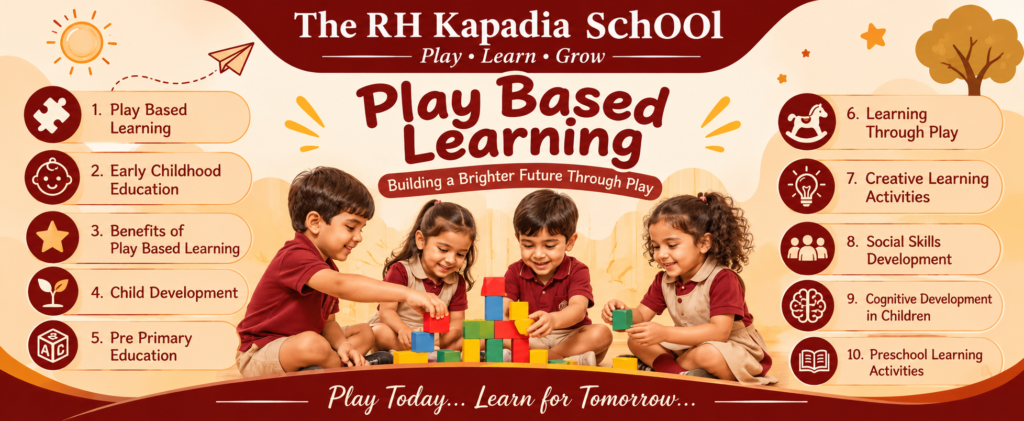
During early childhood, children often have a great deal of curiosity. They like to explore, ask questions, interact with others and understand how things work. Play based learning can help support the development of children’s confidence, communication skills and overall development.
What Is Play Based Learning?
Within play based learning, children can gain knowledge and skills. It allows children to gain knowledge from fun activities.
For example, building blocks can help children understand shapes, sizes, balance and patterns. Playing group games helps children to communicate with others, take turns and work as a team.
A teacher can support children through asking questions, encouraging exploration and helping them understand. Compared to other learning methods, play based learning means that children can be actively involved in their learning. Children can test out ideas and learn at their own pace.
Benefits of Play Based Learning
1. Creativity
As children have active imaginations, creative play can allow them to express ideas. Activities such as drawing, painting, modelling with clay, playing games and creating stories can encourage creativity. Children can learn how to use a variety of materials to create something new, and express themselves using different colours, shapes and movements.
Building houses with blocks, or running a shop in role play, means children can use their creativity to create a scene and work out how to make their idea work. This encourages independent thought and children to be more confident in expressing themselves.
2. Improved Communication Skills
Communication is an important skill to develop in early childhood. Through play based learning, children can improve their communication skills. Playing group games, singing, role-play and picture-based games can all help children to learn new words, and understand how to express themselves.
In role play activities such as in a classroom or shop, children can improve how they communicate with others. They can answer questions and explain what they want. These small activities mean children can gradually improve their vocabulary, listening skills and confidence in speaking.
3. Social Skills
Children need to interact with others to develop social skills. Playing group games or working as a team means children can learn to share, take turns, follow instructions and respect other people’s ideas.
Sometimes, children may have a disagreement in a game or struggle to share a certain toy. With gentle support from teachers, children can learn how to cope with these situations and come up with solutions. These activities can give children many social skills such as:
- Sharing resources with others
- Respecting others in group activities
- Taking turns
- Working as a team
- Understanding how others may feel.
This means children can confidently interact with others both in class and in social situations.
4. Problem Solving Skills
Young children can learn many things through experimentation. By giving children the opportunity to experiment, they can understand how things work. Simple problem solving activities include puzzles, matching games, building blocks and sorting. These activities encourage logical thinking.
In puzzles children can recognise different shapes, match the correct pieces together and problem solve to complete the puzzle. Counting items, sorting items by size and recognising patterns can allow children to understand basic mathematical concepts.
These activities encourage children to think independently, make decisions and learn from mistakes.
5. Development of Physical Skills
Physical activities are important in children’s development. Running, jumping, dancing, catching and playing games outside can improve balance, coordination and physical movement. These activities improve gross motor skills. Creative activities such as drawing, cutting with child safe scissors, modelling with clay and arranging small objects can improve fine motor skills.
Both fine and gross motor skills are important in everyday tasks such as writing, holding objects, getting dressed and completing tasks in class. A varied learning environment should include opportunities for children to participate in physical activities inside and outside.
6. Increased confidence and Independence
Children can gain confidence from becoming more independent. During play based learning, children can make choices, be creative with ideas and complete simple tasks with less adult support.
By choosing what colours to use in a drawing, creating structures with building blocks or playing in a group activity, children can feel more involved. This can give children a sense of achievement. Children can also understand that it is okay to make mistakes. If they make a mistake, they can try again and understand different ways to complete the task. With support from teachers, children can be encouraged, valued and supported.
7. Enjoyable Learning
If children find learning interesting, they will be much more likely to engage in activities. Play based learning means that children can understand concepts such as numbers, colours, shapes, animals and language more easily.
Within a role play shop, children can be introduced to basic maths such as counting. Singing songs about animals can help children recognise the names of different animals and their sounds. These activities mean that children can relate learning in class to real life, meaning they can understand new concepts more easily. In addition, they will be able to better retain this information. If children are enjoying learning, they may become interested in learning and develop a positive attitude towards education.
Role of the Teacher
To be effective, teachers have an important role in play based learning. Although children can explore independently, with some guidance, children can develop appropriately. Teachers can provide appropriate games for children, encourage questions and give children opportunities to work individually and in groups.
Teachers should also observe children to understand how they interact, communicate and complete activities. This means teachers can understand the individual learning needs of each child and provide appropriate guidance. A good early learning environment for children should provide children with both guided activities and free exploration.
How parents can support play based learning
Children can continue learning at home. Parents can support children’s learning with simple activities. Some ideas include:
- Reading a story with your child. Ask them to identify objects in the pictures and ask them questions about the characters.
- Building blocks. Let children create different shapes.
- Simple tasks. Sorting clothes, organising toys and counting fruits can teach children useful concepts.
- Outside play. Let children run, jump and explore their surroundings.
- Creative activities. Let children draw, colour, paint and model with clay. This encourages creativity.
Rather than focusing on children getting perfect results, parents should focus on getting children to engage in these activities.
Choosing a suitable pre-primary learning environment
When choosing a pre-primary school, it is important to consider factors other than books and the teaching methods used. Consider if children are encouraged to be creative, communicate, be physically active and interact with others. Consider if children get individual support within the school, and if they get to participate in a variety of suitable activities for their age.
With a supportive learning environment, children can explore interests, gain confidence and become independent learners. If you would like to find out more about the learning style at R.H. Kapadia New High School, please contact us today.
Summary
Play-based learning is beneficial in early childhood learning. It allows children to develop communication skills, social skills, physical skills and problem-solving skills. Most importantly, children can develop a love for learning at an early age.
If children are given the right opportunities, support and guidance, playing games can provide meaningful learning and support children’s development, preparing them for further learning.

Related Posts